
Case Study
Transforming Building
Compliance with
Unravel
Bridging the gap between consumers and global experts through secure, on-demand video coaching for personal and professional growth.

1. Introduction & Background
Unravel is an AI-powered platform designed to simplify and automate the complex process of understanding building regulations, obtaining compliance insights, and validating construction project requirements. As a part of the Struck ecosystem, Unravel helps architects, builders, developers, and regulatory bodies quickly analyze policies and ensure that projects follow local laws and building codes.
The platform focuses on removing friction from regulatory research by providing accurate, real-time, and location-based building rule insights.
2. The Problem
Building regulations are fragmented, slow to navigate, and risky to interpret manually.
Regulations are spread across lengthy documents, portals, and legal texts, turning every compliance check into hours of manual work and increasing the risk of costly mistakes.
Complex Regulations
Government codes, zoning plans, and fire safety rules are dense and scattered, making manual search slow and error-prone.
Compliance Risk
Misinterpreting a single rule can trigger project delays, legal penalties, redesigns, and rejected permits.
Disconnected Workflows
Teams juggle multiple sources, files, and tools, making collaboration and traceability around regulations difficult.
3. The Solution
Unravel turns regulation chaos into a single intelligent, project-aware assistant.
By reading, indexing, and interpreting regulations at scale, Unravel delivers instant, location-based compliance insights tailored to each project and its documents.
1. Select the location – municipality, city, or site address.
2. Let AI analyze regulations – zoning, building code, safety rules.
3. See risks and fixes instantly – with clear actions and verified sources.
The result is a reduction in manual research time, fewer uncertainties during permitting, and a more confident design and review process.
4 · Key Capabilities
What Unravel unlocks:
⚙️ AI Regulatory Search
Instantly search through large regulation libraries to understand zoning rules, height limits, land-use policies, and more—without reading every page.
✍️ Clear Rule Summaries
Converts dense legal language into concise explanations that architects, contractors, and stakeholders can act on immediately.
📄 Project Document Analysis
Upload PDFs, plans, or briefs so AI can detect applicable laws, highlight issues, and suggest changes that improve permit approval chances.
📍 Location-Based Insights
Automatically aligns each project with location-specific zoning codes and building rules based on the exact site address.
✅ Permit-Check Engine
Translates compliance requirements into clear, actionable checks to reduce permit rejections and redesign cycles.
🔒 Verified Sources & Collaboration
Every insight is backed by cited official documents while teams review, comment, and track compliance together in one place.
5 · Workflow
How Unravel fits into projects

Enter project location
AI retrieves relevant zoning and building rules for that address or parcel.

Upload project files
Teams upload PDFs, drawings, and descriptions to bind regulations to designs.

AI analysis
The engine checks compliance, flags risks, and explains impacts clearly.

Insight & reporting
Teams explore dashboards, export reports, and use them in submissions.
6 · About the Platform
STRUCK provides an intelligent, AI-driven interface that helps users understand zoning regulations, technical building requirements, and compliance rules with complete clarity. The platform offers core capabilities showcased through the following workflows.
1. Zoning Assistant
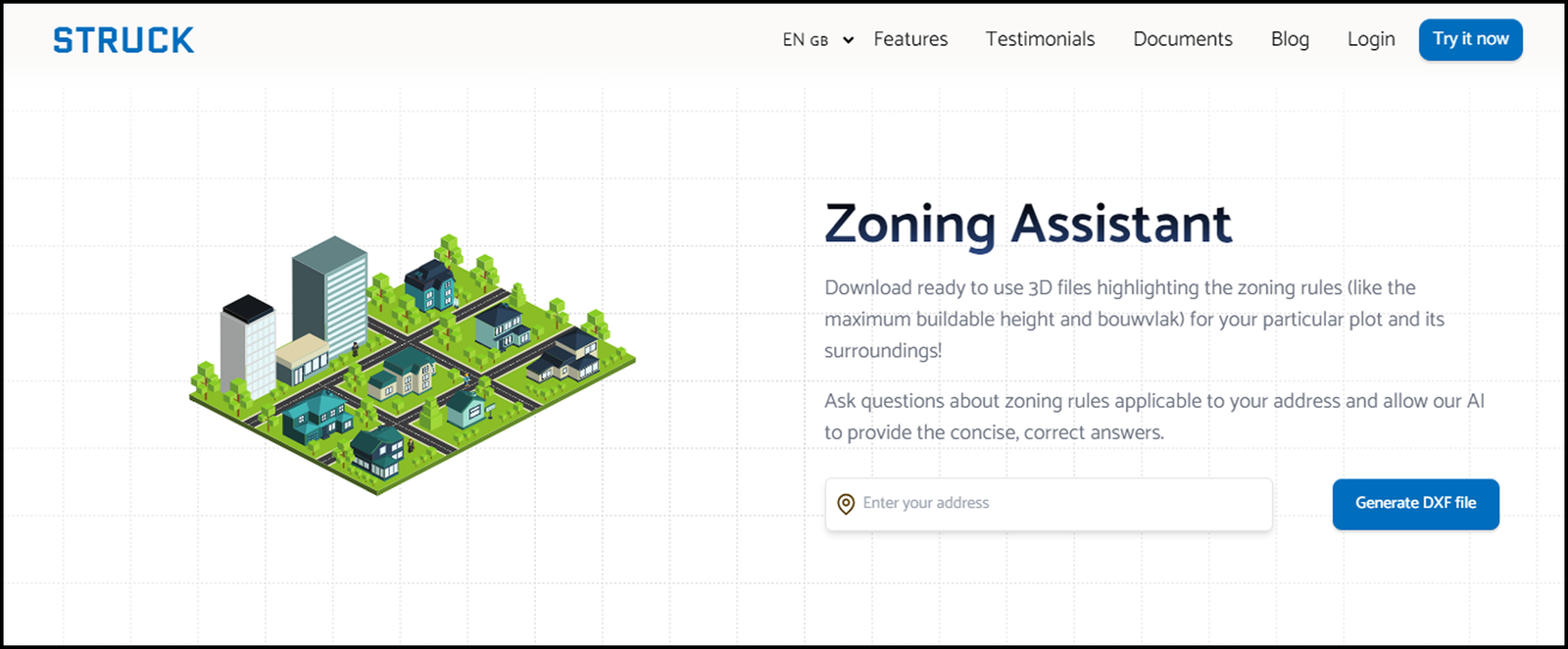
The Zoning Assistant allows users to enter an address and instantly
generate ready-to-use 3D DXF files that highlight zoning rules
applicable to that specific plot.
These include details such as:
- Maximum buildable height
- Buildable area and plot coverage limits
- Surrounding property and setback constraints
- Plot-level development restrictions
This tool helps architects, developers, and planners quickly visualize what can or cannot be built on a plot without manually reading long zoning documents. The interface is simple—users just type an address and download a DXF file containing all zoning data.
2. Technical Compliance Assistant
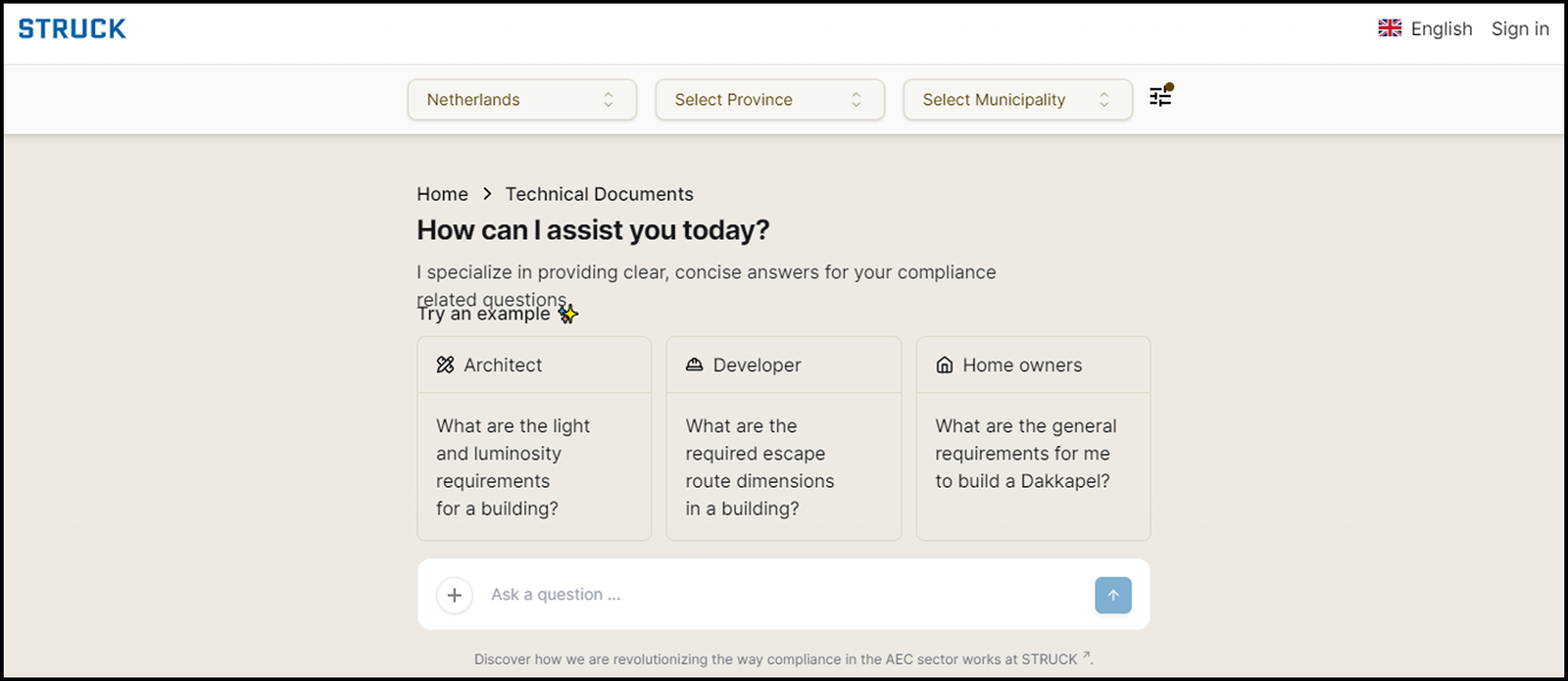
The STRUCK’s AI-powered Technical Document Assistant, designed to
answer compliance-related questions in a clear and concise way.
Users can choose their role:
- Architect → e.g., “What are the light and luminosity requirements for a building?”
- Developer → e.g., “What are the required escape route dimensions?”
- Homeowner → e.g., “What are the general requirements to build a Dakkapel?”
The platform allows users to:
- Select their country, province, and municipality
- Ask compliance-related questions
- Receive verified, simplified, and actionable answers
- View official references and regulation sources
This system eliminates confusion caused by long legal documents and provides tailored answers based on the user's project location.
7 · Tech Stack
Modern AI-native architecture
🖥️ Frontend Technologies
- Next.js, React – Built interactive, high-performance UIs with SSR/CSR support.
- TypeScript – Ensured type-safe and scalable frontend architecture.
- Tailwind CSS, shadcn/ui – Designed modern, responsive, component-driven interfaces.
- HTML5 – Structured robust, SEO-friendly layouts.
⚙️ Backend & API
- Python, FastAPI – Developed fast, asynchronous APIs for AI and data processing.
- ezdxf – Automated DXF generation and CAD-related transformations.
- Aggregation Pipelines – Optimized data computation for analytics and automation.
- Docker – Containerized backend services for portability and deployment.
- Kubernetes – Managed scalable service orchestration and workloads.
🗄️ Database & Storage
- MongoDB – Flexible schema design with fast queries and aggregations.
- VectorDB – Vector-based retrieval for advanced AI and RAG workflows.
🤖 AI & Automation
- AI Chatbot Integration – ChatGPT-based conversational workflows.
- LangChain – Enhanced retrieval, document analysis, and RAG automation.
- LangGraph – Structured AI agent flows using graph-based logic.
🌍 GIS & 3D Processing
- ArcGIS – Spatial data handling and location-based processing.
- 3D Buildings – Converted 3D building models into DXF (AutoCAD) formats.
🛠️ Monitoring & Code Quality
- Sentry – Real-time error tracking and debugging.
- SonarCloud – Automated static analysis to maintain high code quality.
8 · Target Users
Built for every stakeholder around a building permit.
Key Benefits
For Architects & Builders: Faster project planning, instant rule checks, and reduced time spent parsing lengthy regulations.
For Developers: Fewer rejected permits, stronger client-facing reports, and reduced compliance risk across portfolios.
For Governments: More accurate submissions, faster approvals, and clearer alignment with building codes.
9 · Impact
From manual research to AI-native compliance
70–90%
Reduction in time spent on compliance research for typical projects.
Higher Approvals
Improved permit approval rates driven by clearer rule alignment.
Aligned Teams
Architects, developers, and regulators work from the same trusted rule source.
Fewer Errors
Reduced documentation and interpretation mistakes through AI cross-checks.
10 · Conclusion
Unravel sets a new standard for AI-driven regulation intelligence.
By compressing weeks of regulatory research into minutes and surfacing risks before they become delays, Unravel modernizes how building projects are evaluated, approved, and delivered.